
NAFLD- What is it?
Learn all about it’s causes, signs & symptoms
Non-alcoholic Fatty Liver Disease is becoming increasingly common, and understanding its implications is crucial.
Of late, whenever I order a prescription for my patients to get their abdominal ultrasound sonogram done, I have noticed the mention of liver health, such as an enlarged liver with either Grade 1, 2, or 3 fatty liver.
Understanding Non-alcoholic Fatty Liver Disease can provide insights into your overall liver health.
So, what does this indicate for you if your doctor or physician has told you to get the USG done and found any one of the findings mentioned above? Let’s find out in this article.
Disclaimer
The information in this article is intended for reference purposes only, is informative in nature, and is not intended as individual advice. I advise consultation with a qualified health professional or your family physician to assess your individual health concerns.
NAFLD- what it means for you?
Your liver is one of the hardest working organs in your body. It filters toxins, stores energy, and helps digest food. But what happens when fat starts building up in this vital organ? That’s where non-alcoholic fatty liver disease comes into the picture.
Your liver could be slowly filling with fat right now, and you’d have no idea.
That’s the reality for roughly 1 in 3 (30 to 38%) of adults living with Non-Alcoholic Fatty Liver Disease, now known as Metabolically Dysregulated-Associated Steatotic Liver Disease (MASLD) worldwide, more so in South Asian countries like India.
It earns the nickname “silent liver disease” because most people feel perfectly fine in the early stages. No pain. No warning signs. Nothing.
But left unchecked, that fat buildup can trigger inflammation, scarring, and eventually serious liver damage (see below).
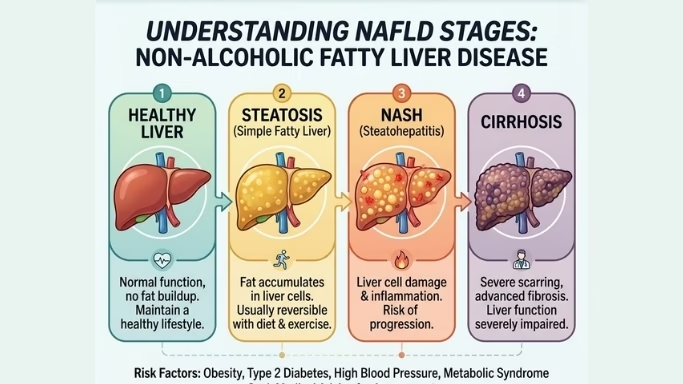
The tricky part is that MASLD is closely tied to everyday health issues many of us already deal with, things like carrying extra belly fat, high blood sugar, or elevated cholesterol. It’s not just a liver problem. It’s a whole-body problem.
The good news is that MASLD is one of those conditions where your daily choices can make a real difference. In this post, you’ll learn what causes fatty liver disease, how to spot the symptoms, how it’s diagnosed, and most importantly, the specific dietary and lifestyle changes that can help you turn things around.
Non-Alcoholic Fatty Liver Disease (NAFLD/MASLD): Causes, Signs & Symptoms
What is Non-Alcoholic Fatty Liver Disease (NAFLD/MASLD)?
The medical community recently gave this condition a new name. NAFLD is now called Metabolic Dysfunction-Associated Steatotic Liver Disease, or MASLD for short. The name changed to better reflect what’s actually happening in your body.
Here’s something important to know-
A healthy liver contains very little fat, almost none. Fatty liver occurs when fat makes up more than 5% of your liver’s total weight. Think of it like a sponge that’s supposed to be mostly dry but has become waterlogged.”
A healthy liver contains very little fat, almost none. Fatty liver occurs when fat makes up more than 5% of your liver’s total weight. Think of it like a sponge that’s supposed to be mostly dry but has become waterlogged.”
MASLD can get worse over time. It can progress to a condition called Metabolically Dysregulated-Associated Steatohepatitis, which doctors abbreviate to MASH. The difference matters.
MASH involves both fat buildup and inflammation in your liver tissue. This inflammation is your body’s alarm system going off, signaling that something needs attention.
Left unchecked, MASH can lead down a dangerous path. Long-term scarring called fibrosis can develop. Your liver can harden into a condition called cirrhosis. Liver failure becomes a real risk. The chances of developing liver cancer also increase significantly.”
Left unchecked, MASH can lead down a dangerous path. Long-term scarring called fibrosis can develop. Your liver can harden into a condition called cirrhosis. Liver failure becomes a real risk. The chances of developing liver cancer also increase significantly.”
This isn’t some rare condition that only affects a handful of people. About 1 in every 3 Australian adults has some degree of fatty liver. That’s a staggering number when you think about it.
In India, where my medical practice is centered, the situation is similar. A study in 2021 revealed that almost 38 to 40% people are affected to some extent.
Key Causes for NAFLD/MASLD-Who is at risk?
Healthcare providers still don’t know the exact cause of fatty liver. The picture isn’t completely clear. But certain health conditions are definitely connected. Let’s what these are-
Obesity: Being overweight or obese tops the list of common causes. Belly fat seems to be particularly problematic. That spare tire around your waist isn’t just a cosmetic concern.
Insulin resistance : This plays a huge role, too. This happens when your cells don’t respond properly to insulin and can’t take up sugar effectively from your bloodstream. Your pancreas works overtime trying to compensate, leading to fat deposition in the liver and abdomen.
High blood sugar is another red flag. If you have prediabetes or Type 2 diabetes, your risk shoots up. These conditions go hand in hand with fatty liver more often than not.
Cholesterol: Your cholesterol levels matter too. High levels of fats in your blood, particularly triglycerides or LDL cholesterol, contribute to fat deposits forming in your liver. The fat has to go somewhere, and unfortunately, your liver becomes the storage unit.”
Your cholesterol levels matter too. High levels of fats in your blood, particularly triglycerides or LDL cholesterol, contribute to fat deposits forming in your liver. The fat has to go somewhere, and unfortunately, your liver becomes the storage unit.”
High blood pressure adds to the risk profile. When all these factors occur together, they form something called metabolic syndrome.
This cluster of conditions often leads to fatty liver and increases your risk of heart disease at the same time.”
This cluster of conditions often leads to fatty liver and increases your risk of heart disease at the same time.”
Other less common causes are:
- An underactive thyroid can contribute.
- Certain medicines may trigger fat accumulation.
- Women with polycystic ovary syndrome (PCOS) face a higher risk.
Sleep apnea and hypothyroidism round out the list of additional risk factors you should discuss with your healthcare provider.
Recognizing the Signs and Symptoms of NAFLD/MASLD
MASLD earned a troubling nickname. It’s called a “silent liver disease” for good reason. Most people feel absolutely nothing in the early stages.
Symptoms can take years to appear. Even when MASH develops, you might not notice anything wrong. Your liver keeps doing its job quietly until the damage becomes significant.
When symptoms do show up, they’re often vague. Some commonly noted symptoms are:
- Severe tiredness becomes a constant companion. You feel weak even after a full night’s sleep.
- Some people experience pain in the right upper belly, right where the liver sits under their ribs.
- Unexplained weight loss can occur, too.
More serious fatty liver disease or cirrhosis brings clearer signs. Jaundice makes your skin and the whites of your eyes turn yellow. This happens because your damaged liver can’t process bilirubin properly.
Other severe symptoms that can develop are:
- Spider-like blood vessels appear on your skin, looking like tiny red webs.
- Long-lasting itching drives people crazy with discomfort. Your urine turns dark, almost brown.
- Advanced stages bring even more concerning problems. Extra fluid builds up in your body because your liver can’t produce the proteins needed to keep fluid in your blood vessels. Your abdomen swells, leading to a condition called ascites. Your ankles and legs puff up with edema.
- The scariest symptoms involve your brain and blood. Your mental abilities can become impaired.
- Memory gets fuzzy, attention wanders, and concentration feels impossible.
- Bruising happens easily because your liver isn’t making enough clotting factors.
- Some people vomit blood or pass black, tarry stools, again due to lack of clotting factors in the blood..
These symptoms can look like other health problems. Never try to diagnose yourself. A healthcare provider needs to figure out what’s actually going on.
Before I close up, here is a video summary of what we have discussed today:
Affiliate Disclosure
Some links in this article are affiliate links. This means:
- If you click a link and make a purchase, I may earn a small commission.
- You pay nothing extra—your price stays the same.
- Your purchase helps support this site and keeps new content coming.
Thank you for your support.
Final words
Now that you have understood what causes non-alcoholic fatty liver disease, we will discuss the diagnosis and management of this condition in the next article to be published shortly.
Spread the word by sharing this article on social media below. Thank you.
Adios.
