

Learn how this herbal remedy improved my health
…and how it can help you too.
Hi friends,
Today , I am going to share a personal journey into the power of a herbal product known as Ashwagandha.
Hi, I am Dr. K. P. V. Rao. At seventy years of age, I’ve learned to value the subtle power of herbal or natural remedies, as I have been going through ups and downs of health due to aging.
Ashwagandha has been one of the most beneficial additions to my wellness regimen.
In this article, I will take you through all the salient features of ashwagandha that helped improve my health followed by other features in next two articles after this one.
My Health Journey Using Ashwagandha
I started taking ashwagandha in its tablet form with modest expectations of better health over time. In addition to my regular medicines for hypertension, hypothyroidism and arthritis, I have noticed that it supported discernible improvements in my general health, muscle strength, memory, thyroid function, joint comfort and even high blood pressure.
These improvements were gradual, yet uplifting and incredibly empowering. But these changes did not occur overnight.
They reminded me that when we provide the proper support the body responds beautifully.”
As my health improved in the way I wanted, I thought that I should share this experience with you through this article.
A short note on history of Ashwagandha
Ashwagandha has a long history of making people feel their best whether you’re looking to increase vitality, manage stress, support strength or just investigate a reliable herbal supplement.”
Functional, Nutraceutical, and Health-Endorsing Perspectives of Ashwagandha
I hope my story encourages you to find out more and see how this amazing herb might help you on your own journey to better health.
Ashwagandha: What Is It?
Ayurvedic medicines long history with ashwagandha
One of the most revered herbs in Ayurvedic medicine, this herbal remedy has been used in traditional Indian medicine for more than 5000 years. India’s oldest healing system- the Ayurveda- has relied heavily on this potent adaptogen whose use dates back to ancient Vedic texts.
I recently wrote a piece about using herbal remedies to improve joint health. If you havent already heres the link to this article: Herbal Remedies.
Ashwagandha’s traditional reputation can be inferred from the name alone. Combining the Sanskrit words ashva (horse) and gandha (smell) it literally means smell of horse.
This name wasn’t just given for its smell- ancient practitioners thought the herb gave people who regularly ate it the stamina strength and vigor of a stallion. It is widely recognized for its use as a tonic that increases energy and improves memory.
Throughout the ages it was referred to as Indian ginseng and winter cherry and was categorized as a rasayana, a medicine thought to improve mental and physical well-being revitalize the body and prolong life.
In the past adaptogen was used to treat an astounding variety of illnesses. It was used by healers to
- ease nervous exhaustion,
- lower fever,
- increase immunity and
- treat inflammation.

In periods of weakness or recuperation it was especially prized for its capacity to help the body withstand stress and regain vitality.
The wisdom ingrained in these age-old healing practices is highlighted by research published in the Journal of Alternative and Complementary Medicine which demonstrates the value of many of these traditional applications.
The top ten advantages of this herbal remedy will be discussed throughout this article with a summary provided at the conclusion.
Active Compounds and Botanical Profile
Let’s now learn about the Botanical aspect of this medicine. Ashwagandha scientifically called Withania somnifera is a member of the Solanaceae (nightshade) family similar to tomatoes and aubergines or brinjal. This perennial shrub is mainly found in arid parts of Africa the Middle East and India.
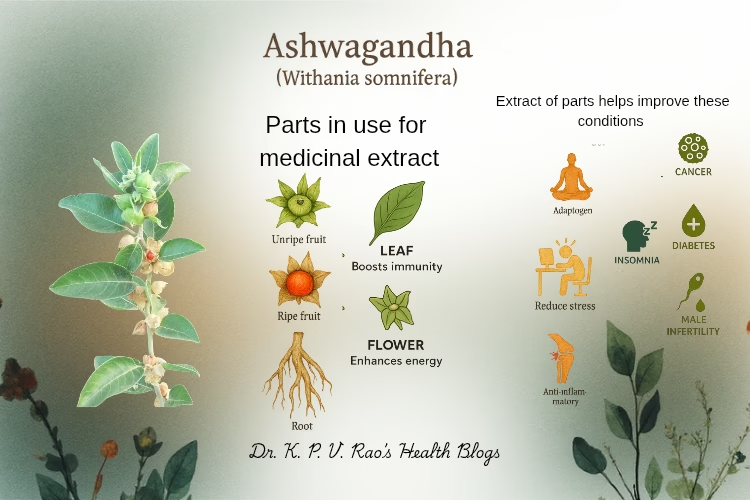
All the plant parts of this shrub are used to make extracts for a range of medical conditions. The plant grows to a height of roughly two feet and produces tiny green flowers that eventually turn into orange-red berries that resemble tiny tomatoes.
What makes Ashwagandha a powerful Medicine?
Ashwagandha’s rich biochemical composition is responsible for its potent therapeutic benefits.
The most important of all are the more than 35 chemical compounds found in the plant are withanolides which are steroidal lactones with anti-inflammatory and antitumor effects.
Saponins, different glycosides, and alkaloids (such as isopelletierine and anaferine) are additional bioactive substances. Together these substances give the herb its adaptogenic properties.
What exactly is an adaptogen?
An adaptogen is a naturally occurring substance that is thought to support general balance of body activity and help the body adjust to stress. Ashwagandha and other adaptogens help the body react to physical and emotional stressors in a positive way.
In this article, I will also provide a downloadable list of other adaptogens that help improve our health.
They improve stability and resilience by assisting in the regulation of physiological processes. These herbs have the potential to enhance mental clarity and focus by fostering a state of equilibrium.
Conclusion
Here we conclude the first part of this series. In my next article we will learn how this adaptogen helps improve our health.
Disclosure:
Some of the links in this article are affiliate links. That means if you click and buy something, I may earn a small commission — at no extra cost to you. It’s a simple way to support this site and keep the content coming. Thanks for your support!
